
How Content Authoring Works in an Agentic AI LMS for Enterprise Learning

Enterprise learning does not have a content shortage. But it does have a content effectiveness problem.
Even though companies are sitting on vast reserves of knowledge with all the product expertise, operational know-how, compliance frameworks, customer insights et al, there’s a struggle to convert the knowledge into learning that actually keeps up with the business.
Over the past decade, LMS and LXP investments have improved how learning is distributed and discovered. But in recent times, they have left a deeper operational issue largely unresolved: how enterprise learning content is created, maintained, and kept relevant at scale. Today, many organizations face challenges where course production is slow, updates are still manual and personalization is often cosmetic. And instructional design teams remain largely overwhelmed, caught in an endless cycle of build-launch-rebuild.
Meanwhile, roles are evolving faster than curricula can be rewritten. Skills requirements shift quarterly, not annually. In this environment, the traditional content production model is not just inefficient. It is, to some extent, structurally misaligned with how modern organizations operate.
What enterprises need now is not another authoring tool layered onto an old workflow. They need a different architecture altogether: one where content creation is continuous, adaptive, and tightly connected to skills, roles, and performance data.
An Agentic AI LMS model is proving to be a strong fit for this new way of building learning.
What “Agentic” Changes in Content Authoring
In an enterprise AI LMS, autonomous learning agents support the end-to-end authoring lifecycle while keeping humans in control of strategy and quality. This shift is not cosmetic. Rather, it is operational.
Here’s why:
- Authoring Begins with Enterprise Knowledge, Not Blank Pages
Agentic systems ingest existing organizational knowledge like documents, SOPs, presentations, product guides etc and convert them into structured learning assets.
AI Agents can:
- Break down raw material into logically sequenced learning modules
- Generate assessments that validate comprehension and application
- Suggest instructional patterns suited to the subject matter
This reframes AI course authoring as transformation rather than invention. Learning teams are no longer starting from scratch. They are shaping and refining AI-generated structures grounded in real enterprise knowledge.
- Content Is Designed Around Roles and Skills from the Outset
In a traditional LMS, content is built generically and mapped to audiences later. In an Agentic AI LMS, role and skill context inform authoring decisions from the beginning.
AI agents reference job role definitions, skill taxonomies, proficiency levels etc to tailor content depth, examples, and assessments. The result is AI-powered learning content that feels purpose-built for the learner’s role, rather than broadly applicable but weakly contextualized.
- Content Evolves Continuously Instead of Waiting for Refresh Cycles
Business environments shift constantly. Regulations change, products are updated and processes are redesigned. This means, in static systems, content runs a higher risk of quickly becoming outdated.
But Agentic content authoring introduces a feedback-driven model:
- When source materials change, agents flag impacted learning assets
- When learner performance indicates gaps, assessments and explanations can be refined
- When skill requirements shift, learning paths can be restructured
All in all, content becomes a living system: one that adapts alongside the business rather than lagging behind it.
- Authoring Connects Directly with Learning Analytics
One of the most underutilized assets in enterprise learning is behavioral data. Most platforms report on completions and scores, but rarely feed those insights back into content design.
In an Agentic AI LMS, content authoring agents operate in a loop with analytics:
- Drop-off points reveal where content may need restructuring
- Assessment trends highlight where explanations lack clarity
- Skill progression data informs where deeper or advanced modules are required
This closes the gap between analytics and content authoring, turning data into an active input for content evolution.
How Enthral.ai Operationalizes Agentic Content Authoring
All said and done though, the real test of the Agentic model lies in its execution.
On platforms like Enthral.ai, Agentic AI is embedded into a unified LMS + LXP architecture where content authoring, skills intelligence, learner engagement, and analytics are all part of a connected system.
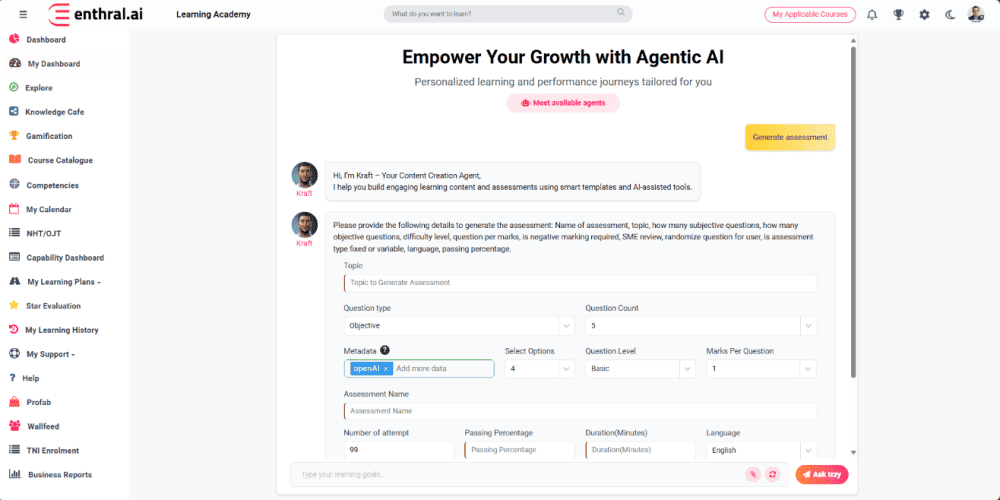
More importantly, content creation is not treated as a side feature. It is supported by a dedicated AI authoring capability working in tandem with an integrated Learning Content Management System (LCMS). Enthral.ai’s Content Creation agent, Kraft, functions as an intelligent co-creator for L&D teams, accelerating production while preserving instructional intent and business context.
Here’s how that looks like:
1. Transforming Raw Knowledge into Structured Learning
Course and assessment creation are among the most time-intensive responsibilities for L&D teams. Enthral.ai’s AI agent significantly reduces this burden by converting raw enterprise materials into structured learning assets.
From a single source input, the system can generate:
- Bite-sized learning modules aligned to specific skills
- Role-based variations of the same core content
- Knowledge checks and applied assessments
This allows content creation to scale without sacrificing role relevance.
2. Multi-Format Content Generation Within an Integrated LCMS
A key differentiator in Enthral.ai’s approach is the embedded LCMS layer that manages content as a dynamic, modular system rather than isolated files.
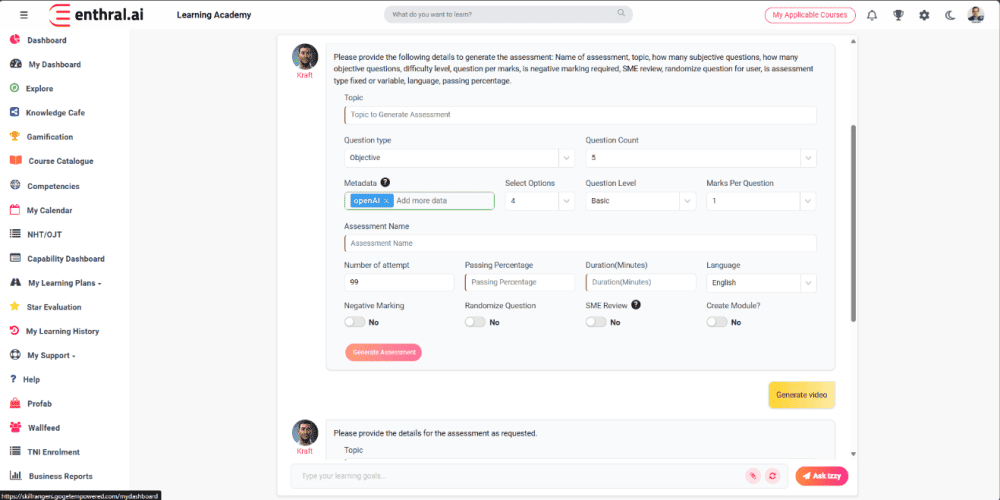
Within this environment, administrators can use AI to generate:
- eLearning modules
- Audio and video learning assets
- Interactive assessments and quizzes
Because all assets are organized within the LCMS, updates can be managed centrally and reflected across formats. This ensures that AI-powered learning content remains consistent, current, and personalized (even at scale) which is key requirement for enterprise environments.
3. Governance Through Human–AI Collaboration
Speed alone is not enough, particularly in regulated industries. Enthral.ai’s model keeps humans firmly in the loop.
L&D leaders and SMEs can:
- Review AI-generated structures
- Refine instructional intent
- Approve final versions before deployment
While AI handles transformation and structuring, humans can still ensure contextual accuracy and pedagogical integrity. This collaboration allows enterprises to benefit from automation without losing control.
4. Linking Content to Skills, Engagement, and Performance
Because Enthral.ai is built as an Agentic AI learning platform, authored content does not sit passively in a catalog.
It connects directly with:
- Skills frameworks that drive role readiness
- Engagement agents that nudge learners at the right time
- Simulation and coaching agents that reinforce application
- Analytics engines that surface impact and gaps
This ensures that content is not only created faster, but also used more effectively which helps close the loop between AI content authoring, learner behavior, and business capability.
Parting Thoughts
For senior L&D and HR leaders, the promise of Agentic AI in content authoring is not simply efficiency. It is structural leverage.
When content can be created, adapted, and governed at scale, learning teams move from production to strategy. Skills also start becoming measurable and are actively developed while training aligns more tightly with evolving business priorities.
The question is no longer how quickly a course can be built, but how intelligently learning content can evolve alongside the organization. Agentic AI makes that possible. Platforms like Enthral.ai demonstrate what this looks like in practice: a system where AI course authoring, LCMS-driven content management, skills intelligence, and learner analytics operate as a unified engine for enterprise capability development.
In that model, content is no longer a constraint. It becomes a continuously improving asset: one that grows with the workforce it is designed to support.
Take a closer look at how Enthral.ai brings Agentic content authoring to life
FAQs
1. What is content authoring in an Agentic AI LMS?
It is a continuous, AI-assisted process where enterprise knowledge is transformed into structured, role-aligned learning assets that evolve based on skills data, learner behavior, and business changes.
2. Where does enterprise knowledge come from for AI-driven authoring?
YAgentic systems ingest existing organizational materials such as SOPs, product documents, presentations, and operational frameworks, converting them into modular learning content within platforms like Enthral.ai.
3. How does an Agentic AI LMS keep content relevant over time?
AI agents monitor changes in source material, learner performance trends, and skill requirements to update modules, refine assessments, and restructure learning paths automatically with human oversight.
4. Why are enterprises adopting Agentic AI for content authoring?
Because traditional content production cannot keep pace with evolving roles and skills; agentic authoring enables scalable, data-driven learning that stays aligned with business priorities.